Scoresheets
Kinds of scoring line
Every line counts something and turns it into points. These are the ways it can, in the order the Add a category library lists them.
Each line has a count: the thing players type or tally, like "Eggs". A count's name is what people see when they score, so name it for what's on the table. Two lines can read the same count (Use a count from another category), which is how one number can score twice, say once as points and once for a majority; Give this category its own count splits them again. Each kind below shows the example it arrives with from the library.
Points you add up
For points that are already printed, on cards, tiles or a track. Players type the total and it scores as it is.
| You set | Players enter | Scores |
|---|---|---|
| What to add up | A number | That number |
In the library: "Points printed on your cards".
Example: Everdell's "Base points on the cards in your city". A player with cards worth 3, 2, 4 and 1 types "3+2+4+1" and scores 10.
Points per item
For a fixed number of points for each of something. You set the points for one, from 0 to 999, and can limit the total with Limit the points.
| You set | Players enter | Scores |
|---|---|---|
| What to count, points each, an optional limit | How many | How many × points each, up to the limit |
In the library: "1 point per coin left over". With no limit, the line says "no limit".
Example: Carcassonne's fields: "Count Finished cities your fields touch and score 3 points each". Four cities score 12.
Points per item, up to a limit is the same line with a limit of 5 to start with, for things like "1 point per matching card, at most 5".
Points by ranges
For a count that scores in steps, like "2 to 3 sets: 3 points; 4 or more: 7". Each range has From, To and Scores; the last can run on with And more. Below the first range scores 0. Add a range and Remove the last range change how many there are.
In the library: "2–3 sets: 3 points; 4 or more: 7".
| You set | Players enter | Scores |
|---|---|---|
| Ranges and what each scores | How many | The points of the range it falls in |
Example: "1 tree: 1 point · 2: 3 · 3 or more: 7". A player with two scores 3; with five, 7. Ranges can't overlap or run backwards: each starts after the last ends.
Penalty
For points you lose, like "Lose 1 point per unfinished card", which is its example in the library. It works as points per item, taken away (the line says "and lose"), and the limit caps how much can be lost.
Example: with "lose 2 points each, at most 6", four unfinished cards lose 6.
Pick one, it scores
For one choice among several, each worth its own points: which objective you completed, which ending you reached. Each option has a Name and Scores; Add an option for more. Players choose from a Pick menu.
In the library: "Which objective you completed".
Example: "Objective: A scores 4 · B scores 6". A player who completed B scores 6.
Pick a card, count its matches
For a bonus card that scores by how many of something match it. Each card has a name and scores either Per match, a set number for each, or By ranges. Add a card for more. Players pick their card, then type how many match. No card picked scores 0.
In the library: "A bonus card and how many of your cards match it".
Example: two cards, "Forest lover: 2 per match" and "Collector: 1–2 matches: 3 · 3 or more: 6". A player with Forest lover and four forest cards scores 8.
Most wins
For a majority: whoever has the most of something scores the most. You set Points by place (1st, 2nd…, with Add a place; places past the last score 0) and how the ranking works. In the library: "Most of something: 1st 5, 2nd 2".
- First place goes to the most, or the fewest.
- Needs at least 1 to score: a player with none takes no place and scores 0.
- Ties:
- Split, rounded down: tied players add up the places they cover and share them. Two tied for first, with 1st 5 and 2nd 2, score (5+2)÷2 = 3 each, rounded down.
- Share the higher place, skip the next: both take 1st's 5, and the next player is 3rd.
- Share the higher place: both take 1st's 5, and the next player is still 2nd.
Example: "Rank Trains most first: 1st 6 · 2nd 3, ties split". Counts of 5, 5 and 2: the two fives share (6+3)÷2, rounded down to 4 each; the 2 is third and scores 0.
Round goal, ranked
For a goal scored at the end of a round, ranked like Most wins, such as "Round 1: 1st 4, 2nd 1, 3rd 0". Adding one turns on rounds for you, on the next round no other line uses. Players type that round's count at the end, or tally it as they play.
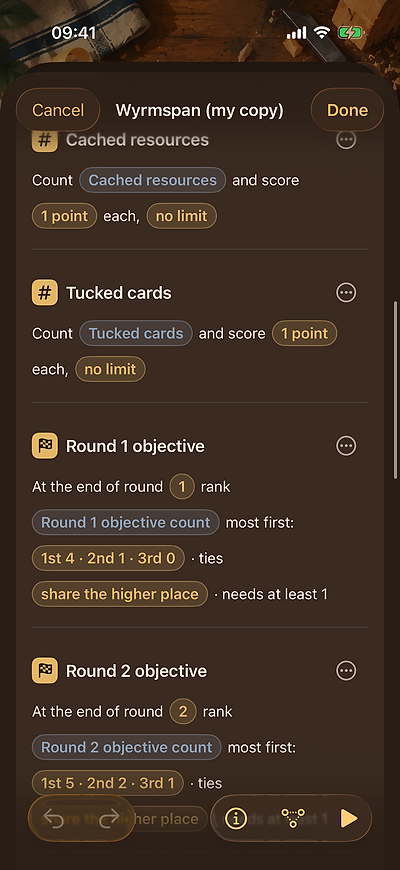
Example: Wyrmspan's round goals score 4, 1 and 0 in round 1, rising to 7, 4 and 3 in round 4. A player with none of the goal's items takes no place, and players who tie share the higher place.
Round goal, per item
For a goal scored per item at the end of a round, like "Round 1: 1 point per item, up to 5", its example in the library.
Worked out from others
For a line that's calculated from another line's points, so nobody has to work it out at the table. It takes a line above it (with none above, it says Add a category above this one first.), then one of:
- plus, minus or times;
- divided by, rounded down, divided by, rounded up, or divided by, rounded, to the nearest, halves up;
- or, whichever is lower, or or, whichever is higher, of the two;
with a number or another line. In the library: "Double your lowest category".
Example: "1 point per 4 items left over, rounded down". Make a line "Items left over" with Points you add up, and turn off Counts towards the total in its ⋯ menu. Then add Worked out from others: "Take Items left over divided by 4, rounded down". Eleven items score 2. See it whole in Wyrmspan's build.
Lines that don't count
Turn off Counts towards the total in a line's ⋯ menu and it shows "Not counted". It's still filled in, still shown, and other lines can still work from it, but it adds nothing to the total itself. Use it for a number that only matters through another line, like the items left over above.